How Much Does Leak Detection Cost?
There is no honest single number, and this page will not invent one. What you will find here is what actually shapes a visit in Columbia: the leak type, where it is hiding, the tools it takes to find it, and why repair is a separate conversation.
Spotted a warning sign? Let’s find the source.
Most leaks are located in a single visit. Call now and tell us what you’re seeing.
Why there is no single number for this
Search for leak detection costs and you will find plenty of confident numbers. Here is the honest version from someone who actually takes these calls in Columbia: the visit is not one job. It is a family of jobs that happen to share a name, and the differences between them are exactly what shape what you pay.
Think of it this way. A toilet supply valve weeping in a guest bathroom can often be traced in minutes, because the source is right there and the test is simple. A hot water line leaking under a slab, on the other hand, may need acoustic listening, thermal scanning, and pressure testing of separate lines before anyone can mark a spot with confidence. Both are leak detection. Nobody honest would quote them the same way without asking a few questions first.
So this page does not publish a figure the business has not confirmed. What it does is walk through the factors that actually move a visit, what a visit typically includes, and the questions worth asking before you hire anyone, including us. If you want a straight answer for your house, call (931) 800-6431 and describe what you are seeing. That conversation is where a real estimate starts.
The factors that shape a detection visit
What kind of leak it is
Supply leaks, drain leaks, and sewer leaks are found differently. A pressurized supply leak makes noise and loses pressure, which gives a technician something to listen for and measure. A drain leak only shows itself when water runs through that drain, so the test has to recreate the conditions, and a sewer leak may need a camera or a different kind of tracing altogether. The leak type decides the toolkit, and the toolkit decides the time.
Where the leak is hiding
Location is often the biggest factor. A leak at an exposed valve or under a sink is quick to confirm. A leak inside a wall takes listening and scanning through drywall. A leak under a concrete slab takes the slow, careful work described on our slab leak detection page, mapping the line first and then narrowing it down. A leak in the yard between the meter and the house is its own job again, covered under underground detection in our service list. The harder a spot is to reach without damage, the more methodical the visit has to be.
Which detection method the job needs
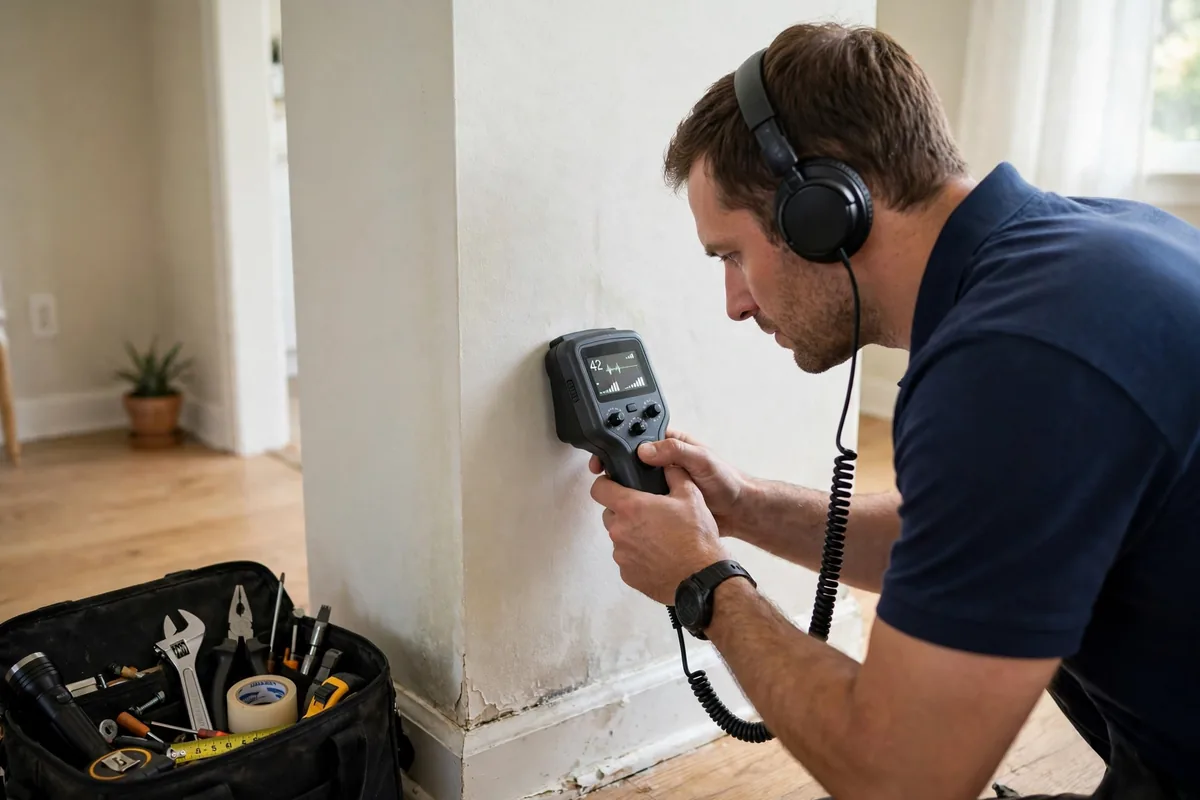
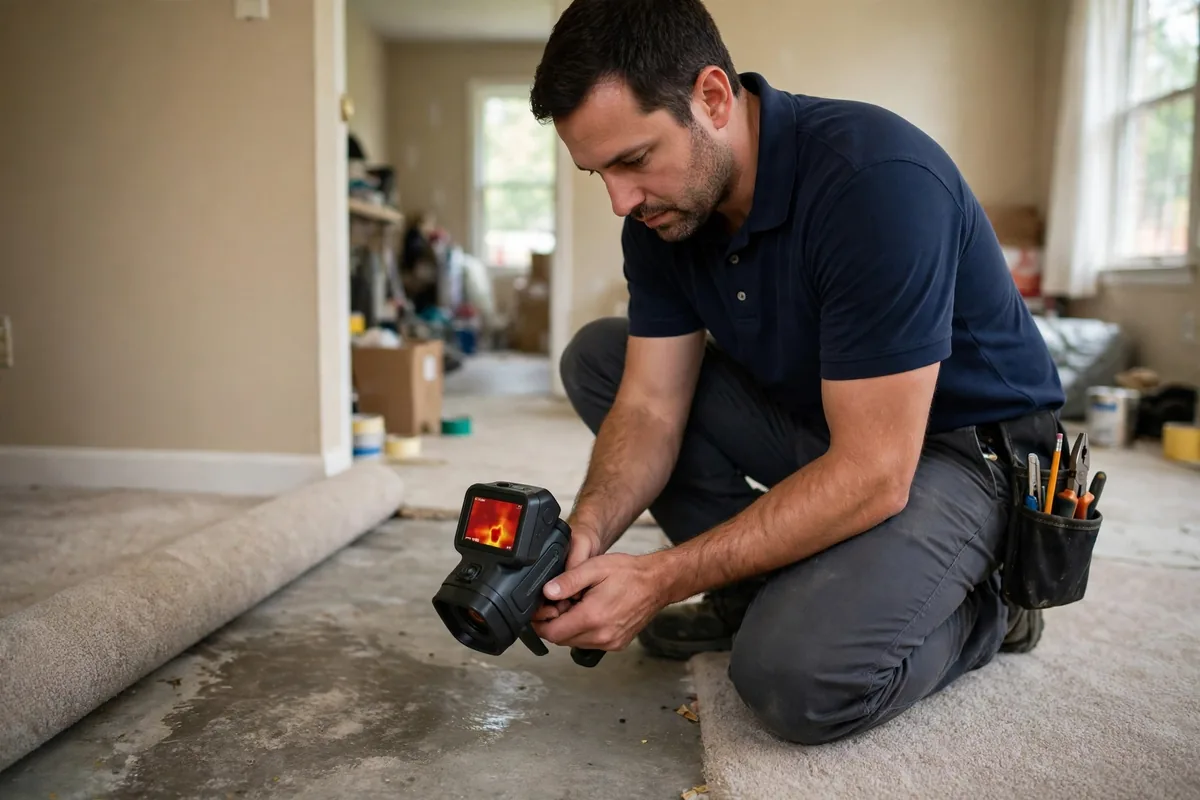
Not every visit needs every tool, and that is part of the point. Acoustic listening is the workhorse for pressurized lines. Thermal imaging earns its keep on hot-side leaks, where escaping water warms the floor or wall above it. Tracer gas can find a cold-side leak that barely makes a sound. Pressure testing isolates one run at a time and proves which branch is losing water. A visit that needs one method and one confirmation is a different job from a visit that needs three methods to agree before anyone marks a spot, and our how leak detection works page explains each method in plain language.
How hard the spot is to get to
Access sounds boring until you have lived it. A crawlspace with a low clearance, a water heater wedged behind stored boxes in a garage, a finished basement ceiling, or a yard line running under a driveway all slow the work down, and they can change which tools will even fit. Clearing a path to the water heater, the main shutoff, and the meter before we arrive is one of the few things that genuinely helps a visit go faster.
Property type and size
A small ranch with one bathroom has fewer branches to test than a two-story home with three baths, a laundry room upstairs, and an irrigation tie-in. Commercial properties add their own layer: longer runs, more fixtures, and sometimes access rules that have to be worked around. Size does not automatically mean a long visit, a big house with an obvious source can be quick, but it does mean more ground to rule out when the source is not obvious.
Urgency and after-hours timing
Water coming through a ceiling at midnight is not the same scheduling problem as a slowly climbing water bill you noticed on a Tuesday. Emergency and after-hours visits pull a technician out outside normal hours, and that is commonly reflected in how the visit is priced. If water is active, shut it off at the main if you can do so safely and call right away. Waiting for a weekday to save on a visit rarely saves anything once water has had the weekend to soak into floors and walls.
Detection is not repair, and that separation protects you
This is the misunderstanding that causes the most frustration, so it is worth saying plainly. Detection finds and marks the leak. Repair fixes it. They are different scopes of work, often done by different crews or on different days, and they are priced separately. A quote that seems to cover everything but only covers detection will feel like a bait and switch when the repair conversation starts, even if nobody intended it that way. Ask, before anyone starts, whether the number you are hearing covers detection only, and what the repair step typically involves from there.
What a visit typically includes
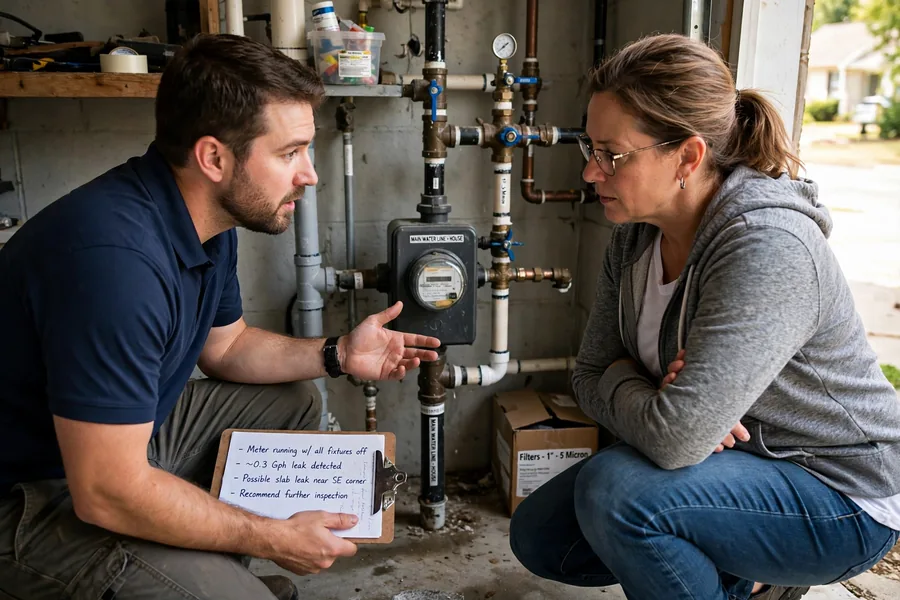
Every company runs its visits a little differently, but a thorough one from Leak Fix Experts follows a pattern you can hold us to. It starts with your story: when you first noticed something, whether the bill changed, what sounds or damp spots you have found. Then comes the meter check with everything off, which confirms whether water is actually leaving the system. From there we isolate branches, listen, scan, and pressure-test as needed until the source is narrowed to a marked spot or a specific fixture. You should leave the visit knowing what was found, how it was confirmed, and what the sensible next step is, in plain language, not a shrug and a bill.
One myth worth correcting: a higher bill does not automatically mean a big leak, and a small drip does not automatically mean a small problem. A slow weep inside a wall can do more damage over months than a burst pipe you catch in an hour, because nobody sees it. That is why the leak symptoms page lists the quiet signs, like a musty smell or a bill creeping up, alongside the obvious ones.
Questions to ask before you hire anyone
Use these on any company, including ours. The answers tell you a lot about how the visit will go.
- What does the visit include, and will you mark the leak location?
- Which detection methods will you use for my kind of leak, and how will you confirm it?
- Is the figure you are giving me for detection only, or does it include repair?
- What happens if the first method does not find it, do you try another approach on the same visit?
- How is an after-hours or emergency visit handled differently from a weekday visit?
- Will I get the findings in writing, so a repair contractor can work from them?
If a company cannot answer those clearly, or pressures you to approve repair work before the leak is actually located, that is information too. Detection first, repair second, in that order, is the sequence that keeps a small problem small. For general water concerns that do not fit one category, our hidden leak detection visit is the usual starting point, and the team behind leak detection in Columbia will talk you through it before anyone picks up a tool. The U.S. EPA also publishes household leak guidance through EPA WaterSense if you want a second, independent reference on where home leaks hide.
Leak Detection Cost FAQs
Why don't you list a fixed price for leak detection?
Because the job changes too much from house to house to quote honestly without seeing it. A visible fixture drip and a supply line buried under a slab are both leaks, but they take different tools, different time, and different access. We would rather explain what drives the visit and give you a straight answer on the phone than publish a number that turns out wrong for your house.
Does detection cost the same as repair?
No, and that distinction matters. Detection is the work of finding and marking the leak. Repair is the separate work of opening up, replacing a section, or rerouting a line. When you call, ask which part a quote covers so you are comparing like with like.
What usually makes a detection visit take longer?
Access and ambiguity, most of the time. A leak behind a finished wall, under a slab, or out in the yard takes more tracing than one at an exposed valve. A home where several fixtures share one run can also take longer, because each branch has to be isolated and tested before the culprit is clear.
Can I lower the cost by doing some checks myself first?
Yes, a little, and it helps us too. Shut everything off and watch your water meter, note which rooms show dampness or sound, and tell us the pattern when you call. That narrows the search. What you should not do is open walls or dig on a guess, since exploratory damage usually costs more to put right than the detection visit would have.
Do after-hours or emergency calls cost more?
They can. A call in the middle of the night or on a holiday pulls a technician out outside normal hours, and most companies in this trade price that differently from a weekday visit. If water is actively coming in, do not wait for business hours to protect the house, but do ask on the phone how an after-hours visit is handled so there are no surprises.
Related Leak Detection Services
Hidden Leak Detection
No visible water, but the bill or the meter says otherwise. We trace it to a source.
Learn moreSlab Leak Detection
Warm floors and water sounds under concrete, pinpointed before any slab work.
Learn moreHow Leak Detection Works
Acoustic listening, thermal imaging, pressure testing, and tracer gas, explained.
Learn more
Want a straight answer for your house?
Tell us what you are seeing, a bill change, a damp spot, a sound, and we will talk through what the visit would involve. No guesswork, no pressure.