Leak Detection in the Bear Creek Area
The Bear Creek Pike area, along US-412 near I-65 Exit 46, is where Columbia's newer subdivisions are growing: Bear Creek Overlook, Bear Springs, and Bear Creek Glen, among others. The homes here are newer and often bigger, two-story layouts with longer plumbing runs, bigger yards, and irrigation systems that get a real workout in summer. This page covers the whole Bear Creek Pike corridor as one service area, because the subdivisions share the same build era and the same leak patterns.

What a Typical Bear Creek Service Call Looks Like
In a two-story home, the call often starts downstairs: a stain on the living room ceiling, paint bubbling under an upstairs bathroom, a drip that appears after someone showers. Or it starts outside, with a strip of yard that stays wet, or a water bill that jumped even though the household routine did not change.
We start with the meter test, then work floor by floor. Upstairs fixtures get checked first when the stain is below a bathroom, and the yard line gets checked when the meter moves but the house looks dry. Longer runs in a bigger home mean more to test, but the method is the same: isolate runs until the losing one shows itself. Columbia's Leak Fix Experts team takes these calls across the Bear Creek Pike corridor, and most are located in a single visit.

Spotted a warning sign? Let’s find the source.
Most leaks are located in a single visit. Call now and tell us what you’re seeing.
Three Things That Bring Us to Bear Creek
Longer runs in two-story homes
A two-story home simply has more plumbing: more runs, more joints, more distance between the manifold and the farthest fixture. A leak upstairs has further to travel before it shows, and it can show in a room that has nothing to do with the bathroom above it. Ceiling and wall leak detection traces the path back, instead of opening the ceiling where the stain happens to be.
Slab plumbing in newer builds
Newer does not mean exempt. Slab lines in these homes are generally in good shape, but a construction nick, a fitting that never fully seated, or ground movement under the slab can still open up a leak. The signs are familiar: a warm tile patch, water sounds when the house is quiet, a bill that climbs. Slab leak detection isolates the run before anyone discusses the floor.
Irrigation and settling yard lines
Big yards here usually mean irrigation, and new subdivisions mean ground that is still settling after grading. Those two facts combine: an irrigation valve that weeps, or a yard line stressed as fill consolidates, can both show up as a soggy strip or a meter that creeps. We separate the two with isolation testing, through irrigation leak detection and underground leak detection, so the fix lands on the right system.
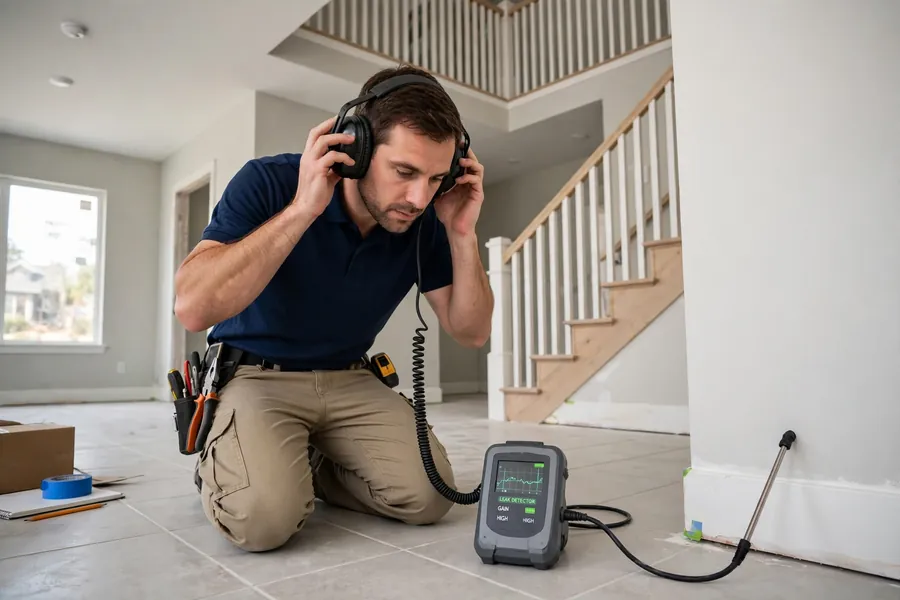
Why Two-Story Leaks Take Longer to Show
Water in a two-story home has options. It can run along a joist bay, soak into subfloor, travel inside a wall, and only appear rooms away from where it started. That is why the stain in the living room might trace back to a kids' bathroom, a laundry room upstairs, or a supply line in the wall between them. Following the stain is not detection. Testing the runs is.
The upstairs laundry deserves a special mention, because it is common in these subdivisions and it concentrates risk: supply hoses, drain standpipes, and a shutoff valve, all sitting above finished space. A slow weep there can wet a ceiling for weeks before it drips. If your laundry is upstairs, it is worth a monthly look behind the machine, checking hoses for bulges and the floor for dampness. It takes two minutes and it catches the kind of leak that otherwise announces itself through a ceiling.
Outside, the same patience applies. A yard line that seeps because the ground settled will not flood the lawn. It will keep one strip green, or keep the meter creeping, and it will get worse slowly. If your bill jumps in a newer home, do the meter test before assuming it is just summer watering. Everything off, 15 to 30 minutes, watch the dial. That single check tells us whether to start inside or out in the yard, and it saves a visit spent looking in the wrong place. For the wider map of where we work, see our Columbia service areas page.
One Corridor, Several New Subdivisions
Bear Creek Pike, US-412, runs past I-65 Exit 46 and anchors a stretch of newer Columbia subdivisions, including Bear Creek Overlook, Bear Springs, and Bear Creek Glen. Rather than splitting these into separate pages, this page covers them together, because they share the same story: newer construction, two-story layouts, longer runs, irrigation-fed yards, and ground that is still settling into place after development.
If you live in one of these subdivisions and your water bill, your ceiling, or your yard is telling you something changed, that is worth a check while the problem is still small. Newer homes reward early detection just as much as old ones do, sometimes more, because the fix is usually a single fitting or a single run, found before it has time to spread.
Bear Creek Leak Detection FAQs
My upstairs bathroom leaked into the ceiling below. How do you find the exact source?
We work from the top down: check the upstairs fixtures, the toilet seal, the shower and tub connections, and the drain and supply runs, then scan the ceiling below to see how far the water traveled. The stain downstairs is rarely directly under the leak, since water follows joists. Testing the runs tells us whether it is supply or drain side, which decides what kind of repair you are looking at.
Our subdivision is only a few years old. Can settling really cause a leak?
It can contribute, yes. New subdivisions involve a lot of grading and fill, and as that ground consolidates over the first years, yard lines and the soil around them shift a little. Most of the time nothing happens. Sometimes a joint gets stressed or a line settles unevenly, and a yard line starts to seep. A soggy strip in the yard or a meter that creeps with everything off is the sign to check, not a reason to panic.
How do you tell an irrigation leak from a main line leak in a big two-story home?
The same way we do anywhere: isolate. Irrigation off at its own valve, watch the meter. If the meter settles, the irrigation system is the suspect and we test its zones. If it keeps moving, the main line or something inside the house is losing water. On a larger home this matters even more, because the irrigation and the house lines cover a lot of ground between them.
Is a slab leak possible in a newer home?
Yes, though it is less common than in older homes. Newer slab lines are usually PEX or copper in good condition, but a fitting issue, a nicked line during construction, or ground movement can still cause one. The signs are the same at any age: a warm patch on the floor, the sound of running water when nothing is on, or a bill that climbs without explanation.
How long does detection take in a larger two-story home?
Longer than in a small ranch, but usually still within a single visit. More fixtures, more runs, and a longer yard line all add time, and a two-story layout means checking both floors and the paths between them. The time is well spent: narrowing the leak to a specific run is what keeps any repair opening small.
Leak Near Bear Creek Pike? Call (931) 800-6431
Ceiling stain under an upstairs bath, soggy yard strip, bill that will not settle down. Tell us what you are seeing and we will trace it.