Leak Detection Methods, Explained
No single tool finds every leak. Here is what acoustic listening, thermal imaging, tracer gas, pressure testing, moisture meters, and cameras each sense, where they fall short, and why a good visit usually combines two or three of them.
Spotted a warning sign? Let’s find the source.
Most leaks are located in a single visit. Call now and tell us what you’re seeing.
First, what this page is and is not
There is already a page on this site that walks through a visit from the first phone call to the marked spot on your floor. That is our guide to how leak detection works, and it is the right place to start if you want to know what happens when a technician shows up at your door. This page is different. It is about the tools themselves: what each one actually senses, what kind of leak it is good at, where it falls short, and why a good visit usually needs more than one of them.
That distinction matters, because no single tool finds every leak. A camera cannot hear a supply line hissing under a slab. A thermal camera cannot see a cold-water leak the same way it sees a hot one. A moisture meter can tell you a wall is wet without telling you where the water came from. The skill is not owning the tools. It is knowing which combination to reach for, and when to trust what they agree on.
Acoustic listening: hearing what you cannot see
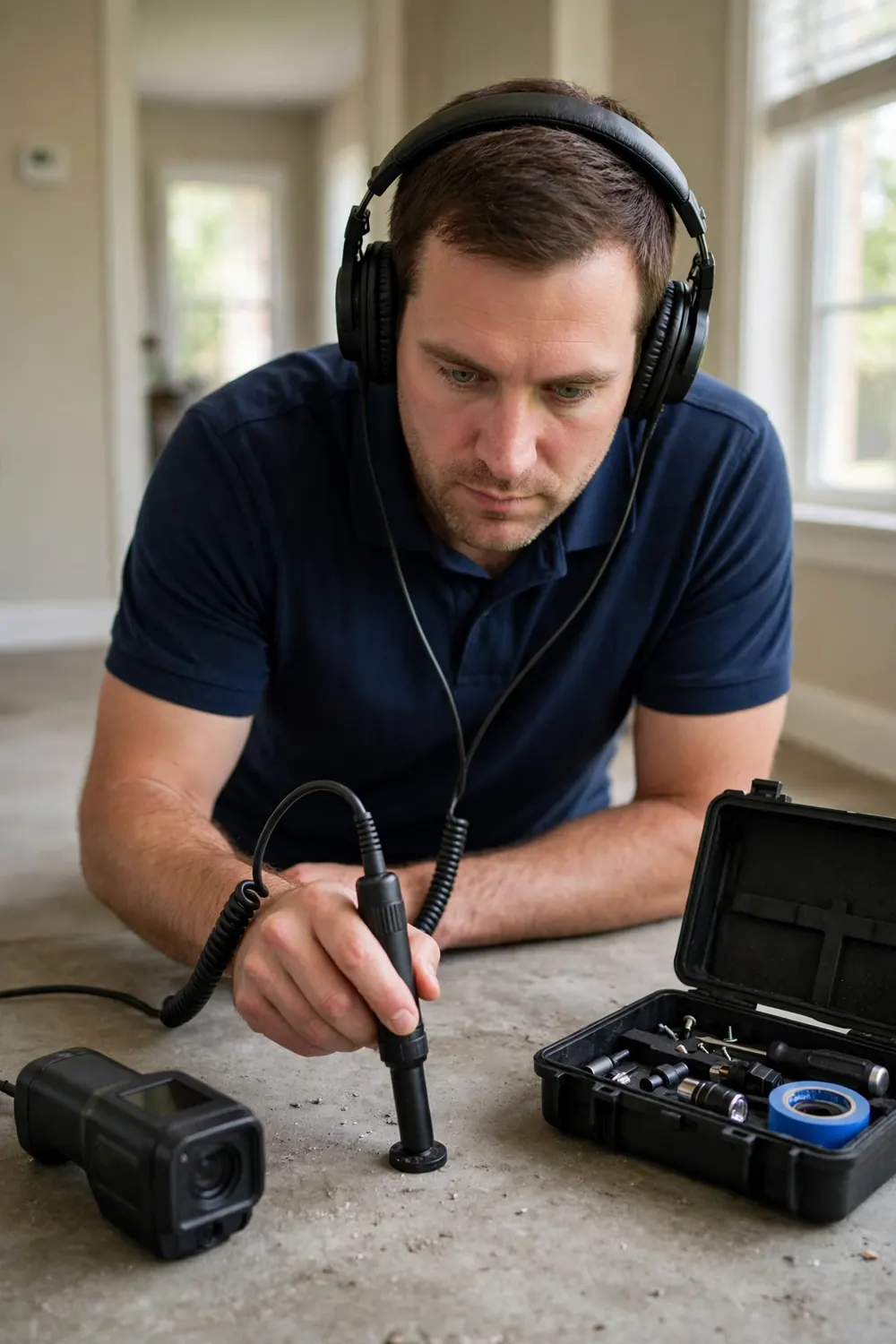
A pressurized supply leak makes noise. Water forcing its way out of a small opening vibrates the pipe, and that vibration travels along the pipe and through the surrounding material. Acoustic listening equipment, basically a very sensitive ground microphone and headphones, picks that sound up and lets a technician compare it point by point across a floor or wall. The loudest, sharpest point is usually the closest to the break.
This is the workhorse method for a reason. It works on hot and cold lines, it works under concrete, and it works without opening anything. On a slab home in Columbia, where the supply lines often run under the floor, it is frequently the method that narrows a whole-house problem down to a few square feet. It is also the method behind much of our slab leak detection work, because a hot or cold line under concrete gives you very little else to go on at first.
It has real limits, though. A slow weep may barely make a sound. Background noise gets in the way: a running washing machine, a humming HVAC unit, traffic on a busy road, even a refrigerator compressor can muddy what the technician hears. That is why a quiet house helps, and why acoustic results are usually checked against another method before anyone marks a spot. Pipe material changes the sound too. Metal pipe carries sound a long way, while plastic pipe tends to muffle it, so the same leak can sound very different in an older Columbia home with copper or galvanized lines than in a newer build plumbed in PEX.
Thermal imaging: reading heat, not water
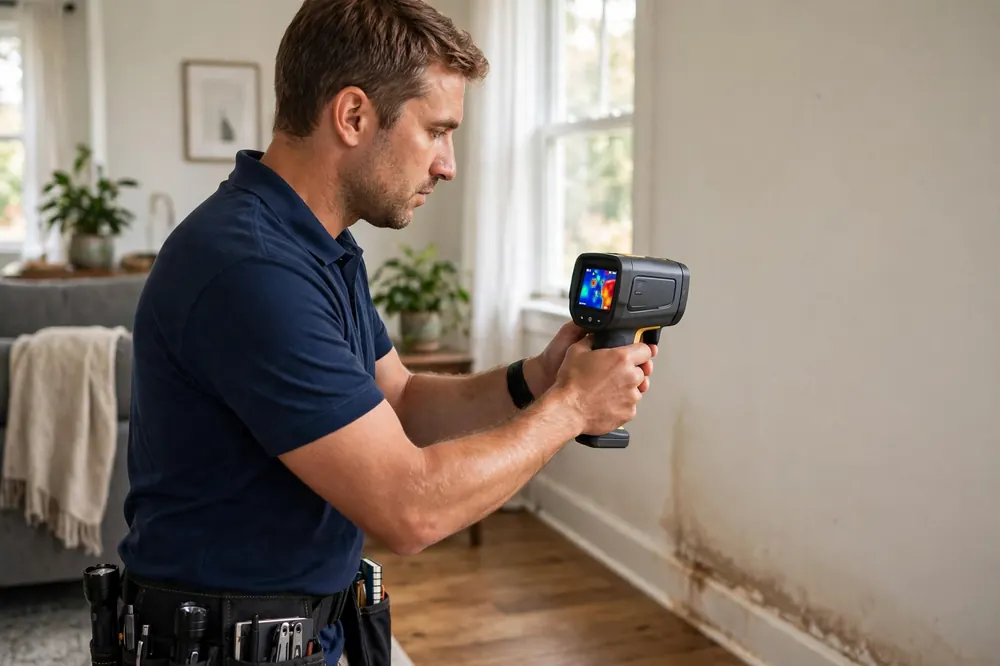
A thermal camera does not see water. It sees temperature differences on a surface, and it paints them as colors. A hot-water leak warms the floor or wall above it, so on a thermal scan it shows up as a warm patch or a warm trail following the line. That makes it a strong tool for hot-side leaks, and it can cover a large room quickly, which is handy when nobody is sure which part of the floor to focus on.
The catch is that it only shows heat. A cold-water leak often leaves no warm signature at all, so thermal imaging can miss it completely. Sunlight through a window can warm a patch of floor and look suspicious. A heating vent, a sunny slab, or even a rug over a warm spot can confuse the picture. Carpet and thick flooring blunt the signal as well. So a thermal image is a clue, not a verdict. On a good visit it points the acoustic listening in the right direction, and the two together are far stronger than either alone. The handheld thermal imagers used for this work, like those from FLIR, display those surface temperature differences as the color patterns described above.
Tracer gas: for the quiet leaks
Some leaks are too small or too well muffled to hear, and too cold to show up on a thermal scan. That is where tracer gas earns its keep. The line is isolated and filled with a light, safe gas mixture, usually mostly nitrogen with a small amount of hydrogen. The gas escapes through the same opening the water does, rises through soil or concrete, and is picked up at the surface by a sensitive detector, often called a sniffer.
It is a useful method for cold-water lines under a slab or out in the yard, and for small leaks that other tools keep missing. It is also a slower, more deliberate method: the line has to be isolated first, and the technician has to work methodically across the surface rather than sweeping a room in minutes. It is not the first tool for every job, and a technician who reaches for it on a simple, obvious leak is probably overcomplicating things. But when acoustic listening and thermal imaging have both come up empty and the meter still says water is leaving the system, tracer gas is often what finally gives a location.
Pressure testing: proving which line is losing water
Pressure testing answers a different question than the other tools. It does not point at a spot on the floor. It proves which branch of your plumbing is losing water. Valves isolate one run at a time, a gauge watches that run, and a falling reading says that branch has a problem. A steady reading says it does not, and the search moves on.
That sounds basic, and it is, but it is what keeps a visit honest. Without it, a technician can spend an hour listening along the wrong line. With it, the search area shrinks before any listening or scanning starts. It is also how a water line leak between the meter and the house gets separated from a leak inside the house: test the service line on its own, and the meter-side question gets a yes-or-no answer. Pressure testing rarely finds a leak by itself, but it is often the step that makes the other methods useful. That same isolate-and-test logic is how a pool plumbing loss gets separated from normal evaporation, as our pool losing water guide explains.
Moisture meters: mapping the wet, not the source
A moisture meter measures how wet a material is, either with small pins pressed into the surface or with a pad held flat against it. Used across a wall or floor, it draws a map: dry here, damp here, wettest here. That map is genuinely useful. It shows how far water has spread, it tells a repair contractor how much material is affected, and it can reveal dampness behind paint that still looks fine.
What it cannot do is name the source. Water travels. It runs along a joist, wicks up drywall, and pools in the lowest spot it can reach, which may be several feet from where it entered. A wet patch in a ceiling does not prove the leak is directly above it, and a damp baseboard does not prove the pipe behind that baseboard is the culprit. That is why moisture readings are paired with listening or scanning, and why our hidden leak detection visits treat the moisture map as a starting point rather than an answer.
Camera inspection: seeing inside drain and sewer lines
A camera on a flexible cable goes inside a drain or sewer line and shows what is actually in there: a crack, a joint that has shifted, roots growing through a gap, or a section that has sagged and now holds water. For drain and sewer problems, this is often the method that settles the argument, because you are looking at the pipe itself rather than inferring from a sound or a temperature patch. Inspection camera systems like those from RIDGID are the usual tool for this kind of drain and sewer inspection.
Its limits are just as clear. A camera inspects the inside of a drain or sewer pipe. It cannot inspect a pressurized supply line from the outside, and it cannot see a supply leak spraying into a wall cavity. So if your problem is a supply leak, a camera is the wrong tool, no matter how impressive the footage looks. The right question is always which pipe is suspect, supply or drain, and the answer to that question decides whether a camera belongs in the visit at all.
How methods combine on one visit
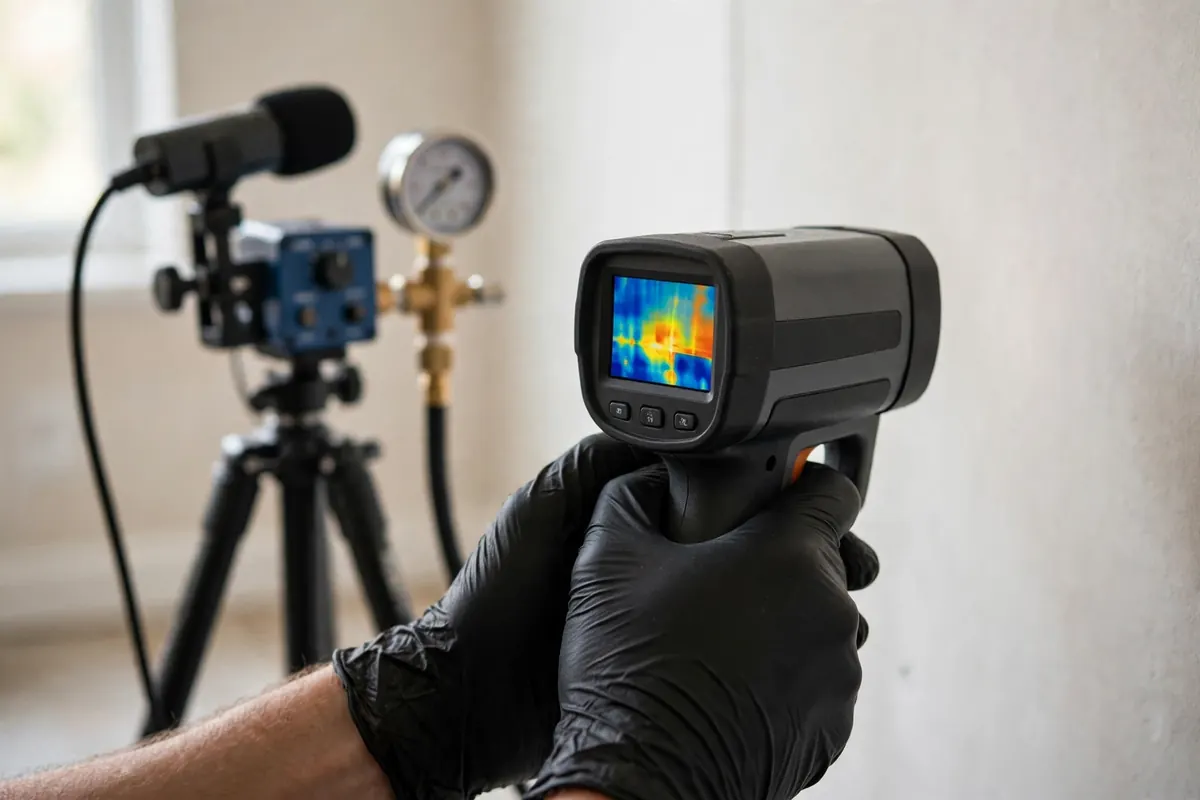
Most real visits use two or three methods, and the combination depends on the symptom. A warm spot on a slab floor might start with a thermal scan to outline the warm area, then acoustic listening to find the loudest point inside it, then a pressure test to confirm that branch is the one losing water. Three methods agreeing is a much stronger basis for marking a spot than any one of them alone.
A soggy patch in the yard tells a different story. The first job is usually to separate the house from the yard, with a pressure test on the service line, and our underground leak detection work often follows that split. If the yard line is the problem, acoustic listening along the line's path and tracer gas can narrow it down before anyone digs. A stain on a wall might start with moisture mapping to find the wettest area, then listening to check whether a supply line behind that wall is actually leaking, or whether the water is coming from a drain or a fixture above.
Columbia conditions shape these choices too. Maury County clay soil holds water and shifts with wet and dry seasons, which can stress buried lines and make a yard leak harder to read, since the ground may stay damp for reasons that have nothing to do with plumbing. Older homes around town may mix pipe materials from different eras, which changes how sound travels. None of that changes the tools, but it changes which tool a technician trusts first, and that judgment is part of what you are paying for.
What no method can do
It is worth being plain about the limits, because overpromising is how homeowners end up with a hole in the wrong place. No tool sees directly through concrete, tile, or soil. Every method reads a signal, sound, heat, gas, pressure, moisture, or a camera image, and the technician interprets that signal. A leak that is very small, intermittent, or on a drain line that only leaks when a particular fixture runs can resist every method on a first visit, and a straight answer in that situation is that more testing is needed, not a confident guess.
If you want the visit itself described step by step, from the first questions to what happens after a leak is marked, read our how leak detection works page. If you want to know what shapes the price of a visit, our leak detection cost guide covers that honestly, with no fixed figures invented for the occasion. And if you are weighing whether to call at all, the team at Leak Fix Experts in Columbia will talk through your symptoms first and tell you whether a detection visit is even the right next step. And if you have a question this page did not answer, our leak detection FAQ page covers the ones homeowners ask most.
Leak Detection Methods FAQs
Which method do you start with for a leak with no visible water?
Usually pressure testing, because it narrows the search before any listening or scanning starts. With everything off and the meter checked, isolating branches one at a time shows which run is losing water. Once that branch is known, acoustic listening or thermal imaging can focus on a much smaller area instead of sweeping the whole house.
Can acoustic listening work through a concrete slab, or does the concrete block the sound?
It can, and slab work is one of its main jobs. Sound from a pressurized leak travels through the pipe and into the surrounding concrete, and a ground microphone picks it up from the floor surface. Concrete does muffle the sound compared with an exposed pipe, and a very slow weep may be faint, which is why slab results are usually checked against a pressure test or a thermal scan before a spot is marked.
Why does thermal imaging work better on hot lines than on cold lines?
Because a thermal camera reads temperature, not water. A hot-water leak warms the floor or wall above it, and that warm patch stands out on the scan. A cold-water leak leaves no warm signature, so the camera may show nothing at all even while water is escaping. That is why thermal imaging is a strong clue for hot-side leaks and a poor first choice for cold-side ones.
When is tracer gas worth it, and when is it overkill?
It is worth it when other methods have come up empty but the meter still says water is leaving the system, especially on cold lines under a slab or in the yard. It is overkill on a straightforward leak that acoustic listening or a pressure test can already pin down, since it takes more setup time. A good technician reaches for it when the easy answers have been ruled out, not as a first move on every job.
Can a camera find a leak, or does it only show the pipe?
It shows the inside of a drain or sewer pipe, so it can reveal a crack, a shifted joint, or roots that explain a drain or sewer leak. What it cannot do is find a pressurized supply leak, because that water is escaping outside the pipe, not running inside it. Cameras belong to drain and sewer work, while supply leaks belong to listening, thermal imaging, pressure testing, or tracer gas.
Related Leak Detection Services
How Leak Detection Works
The visit itself, step by step, from the first questions to the marked spot.
Learn moreSlab Leak Detection
Warm floors and water sounds under concrete, pinpointed before any slab work.
Learn moreLeak Detection Cost Guide
What shapes a visit, with no fixed figures invented for the occasion.
Learn more
Still unsure which method your leak needs?
Describe what you are seeing, a warm floor, a damp wall, a bill that climbed, and we will talk through which tools fit before anyone picks one up.